
INDIA COFFEE SECTOR
India’s coffee sector is gaining global recognition, moving from “Farm to Global Fame” with rising exports and specialty branding.
About
- Origin: Introduced to India in 1600 AD by the Sufi saint Baba Budan, who planted seven beans in the Chandragiri hills of Chikkamagaluru (Karnataka).
- Unique Feature: India is the only country where coffee is grown entirely under the shade of other vegetation (Shade-Grown), making it biodiversity-friendly.
- Key Varieties:
- Robusta (~70%): Stronger, higher caffeine (Grown in lower altitudes).
- Arabica (~30%): Mild, aromatic (Grown in higher altitudes).
Production & Trade
- Rank: India is the 7th largest producer in the world (≈ 3.6 lakh MT).
- Export Focus: About 70% of production is exported.
- Performance: In FY 2024–25, exports hit a record USD 1.8 billion, driven by global price surges and demand for Indian Robusta.
Major Growing Regions
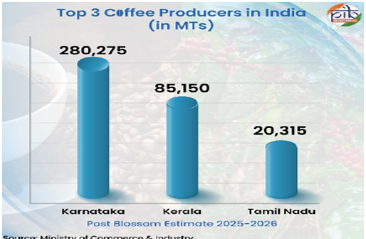
- Traditional: Karnataka (Dominates with ~70%), Kerala, and Tamil Nadu.
- Non-Traditional: Andhra Pradesh and Odisha (Koraput).
- North-East: Emerging plantations in the Seven Sisters.
GI Tagged Coffees (Geographical Indications)
- Coorg Arabica
- Wayanad Robusta
- Chikkamagaluru Arabica
- Araku Valley Arabica
- Bababudangiris Arabica
- Monsooned Malabar: A unique specialty coffee exposed to sea winds during the monsoon, giving it a distinct flavor and golden color.
Success Stories
Tribal Model (Koraput, Odisha): A successful farm-to-cup model with doorstep procurement has significantly raised tribal incomes. The “Koraput Coffee” won the Fine Cup Awards 2024.
Coffee Board of India
- Status: A statutory body established under the Coffee Act VII of 1942.
- Nodal Ministry: Administrative control of the Ministry of Commerce and Industry.
- Headquarters: Bengaluru.
- Composition: 33 members (including Chairman, MPs, growers, and traders).
- Mandate:
- Research & Development (R&D).
- Promotion in domestic and international markets.
- Implementation of the Integrated Coffee Development Project (ICDP) to support drying yards and mechanization.

Subscribe
Login
0 Comments
Oldest